
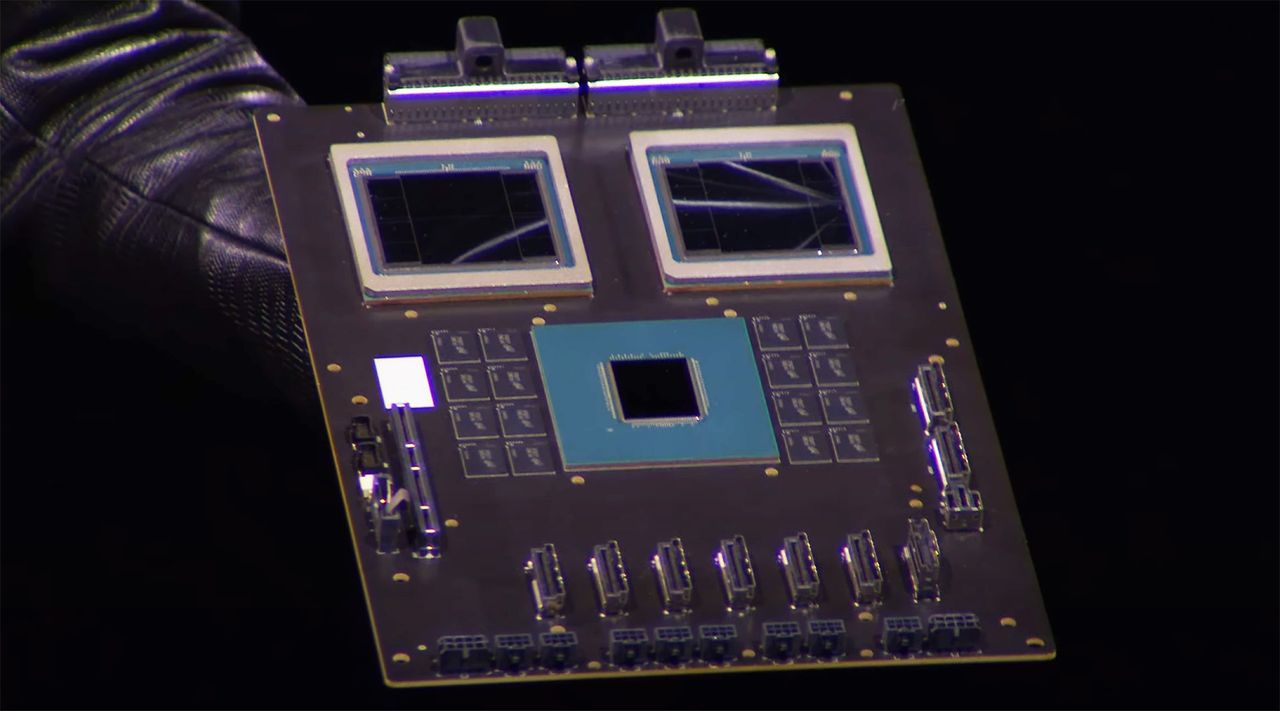
AMD Challenges Nvidia’s CUDA Dominance
In a bold statement that sent ripples through the tech industry, AMD has publicly declared that Nvidia’s proprietary CUDA platform is a “non-event.” This assertion comes at a time when Nvidia has long enjoyed a significant advantage in the accelerated computing market, largely due to the widespread adoption and perceived indispensability of CUDA for GPU programming. AMD’s message is clear: the landscape is changing, and what was once a formidable moat for Nvidia is becoming increasingly porous.
According to AMD executives, the industry is rapidly evolving towards programming at higher levels of abstraction. This means that developers are less concerned with the intricate, low-level details that CUDA often dictates. Instead, the focus is shifting towards more portable and accessible programming models.AMD’s argument suggests that as software ecosystems mature and mature, specialized proprietary technologies like CUDA become less critical. Companies are increasingly prioritizing solutions that offer flexibility and avoid vendor lock-in, a sentiment that AMD champions with its own open-source initiatives like ROCm (Radeon Open Ecosystem).
The core of AMD’s argument lies in the belief that the perceived indispensability of CUDA is an outdated notion. They contend that for many modern applications and development workflows, the specificities of CUDA are no longer the primary determinant of success. This is particularly true for high-performance computing (HPC) and artificial intelligence (AI) workloads, where abstracting hardware differences through robust compilers and standardized libraries is becoming the norm, not the exception.
The Shifting Sands of GPU Programming
The implications of AMD’s statements are significant. Nvidia has built a substantial portion of its market dominance on the back of CUDA’s early lead and its extensive software ecosystem. Researchers, data scientists, and AI engineers have extensively relied on CUDA-enabled frameworks and libraries, making the transition to alternative platforms a non-trivial undertaking for many. However, AMD’s viewpoint highlights a strategic shift: “Not really the moat that some people still think it is.” This suggests that while CUDA may still be prevalent, its ability to act as an insurmountable barrier to entry for competitors is diminishing.
The increasing focus on open standards and cross-platform compatibility is a driving force behind this evolution. Languages and frameworks that allow developers to write code once and deploy it across various hardware architectures, including those from AMD, Intel, and even future custom silicon, are gaining traction. This trend directly erodes the strategic advantage of proprietary technologies that tie users to a specific vendor’s hardware.
Furthermore, the development of more sophisticated compilers and optimization tools can abstract away much of the hardware-specific tuning that was once the purview of CUDA programmers. As these tools become more adept, the need for deep, low-level CUDA expertise diminishes, making it easier for developers to leverage different GPU architectures. This is not to say that CUDA is becoming irrelevant overnight. It remains a powerful and widely used platform. However, its once unassailable position is being challenged by the broader technological trends and the strategic direction of its competitors.
A Lighthearted Anecdote
You know, it reminds me of this one time when I was trying to set up a new smart home system. I had all these fancy gadgets, and they all came with their own proprietary apps and protocols. It was a nightmare! Every device wanted to talk in its own secret language, and I felt like I needed a degree in cryptography just to turn on the lights. I spent hours trying to get my smart plug to talk to my smart bulb, and all I got was silence and a blinking error message. It was like watching my cat try to have a philosophical debate with a toaster – utterly unproductive and slightly absurd. My wife walked in, saw me wrestling with cables and muttering curses at my router, and just asked, “Are you sure you want to invest this much time in a system that requires a PhD in techno-babble?” That was the moment I realized, much like AMD is saying about CUDA, that sometimes the most advanced solutions are the ones that just work, without making you feel like you’re defusing a bomb. I ended up ditching half the gadgets for a more open system that actually communicated properly. It was a revelation – simplicity and compatibility trumping proprietary complexity every time.
The ROCm Advantage?
AMD’s push with ROCm is their answer to this evolving landscape. By offering an open-source software stack, AMD aims to attract developers who are wary of vendor lock-in and are looking for greater flexibility. The success of ROCm will ultimately depend on its ability to mature rapidly, gain broader industry support, and provide the performance and ease of use that developers have come to expect from accelerated computing platforms. However, the initial declaration that CUDA is a “non-event” signals a clear intent to disrupt the status quo and encourage a broader adoption of open, portable programming standards.
The market is large enough for multiple players, and as AI and HPC continue to expand, the demand for efficient and accessible computing power will only grow. AMD’s strategy appears to be capitalizing on a perceived shift in developer priorities, moving away from deep hardware specialization towards more abstract, portable, and ultimately, more liberating programming paradigms. The coming years will reveal whether this bold assertion translates into significant market share shifts, but it’s undoubtedly a compelling narrative for anyone following the future of computing.