
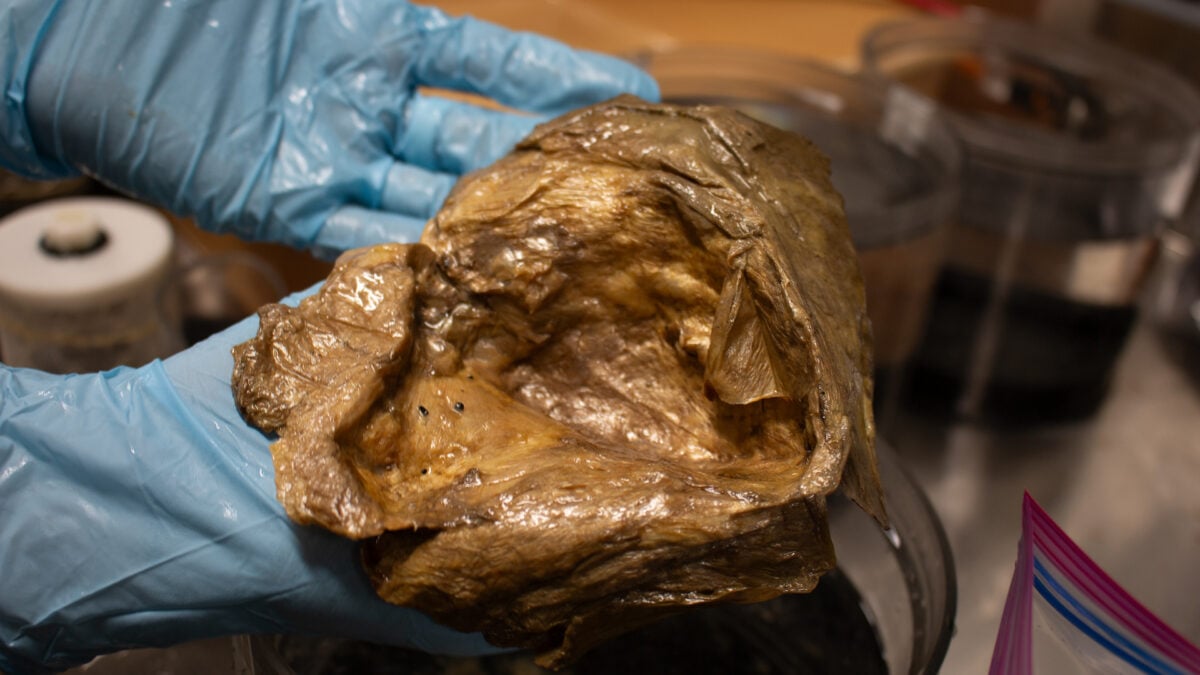
For more than two years, the global scientific community and curious onlookers were captivated by a bizarre discovery made deep within the Gulf of Alaska. In 2023, a remotely operated vehicle (ROV) exploring the ocean floor at a depth of approximately 3,300 meters captured footage of a shimmering, golden orb resting inexplicably on a rock. The object, which appeared to have a jagged hole on one side, sparked a flurry of speculation ranging from the plausible to the fantastical, with many suggesting it could be an alien egg, the remains of an unknown creature, or perhaps a discarded piece of deep-sea technology.
The mystery remained unsolved for an extended period, leading to intense debates among marine biologists. The orb’s texture, color, and anomalous placement defied immediate classification. However, a dedicated team of researchers from the National Oceanic and Atmospheric Administration (NOAA) recently concluded their rigorous investigation, and the results have finally shed light on this deep-sea phenomenon.
After collecting the specimen using an ROV robotic arm and subjecting it to sophisticated DNA analysis and microscopic examination, the team confirmed that the golden orb is, in fact, an egg casing. Specifically, it is the result of a marine organism that has yet to be formally identified or described. The presence of a tear in the surface of the orb suggests that the creature inside had successfully hatched before the object was recovered. This revelation transforms the golden orb from a potential extraterrestrial artifact into a critical piece of the puzzle regarding marine biodiversity.
Understanding Deep-Sea Biological Remains
The ocean floor remains one of the least explored frontiers on Earth. Discoveries like this golden orb highlight just how little we know about the reproductive habits of deep-sea fauna. To put this discovery into perspective, consider the following facts about deep-sea biological finds:
- Extreme Environments: Life at these depths survives under immense pressure, near-freezing temperatures, and total darkness.
- Biological Rarity: Many species residing in the “midnight zone” of the ocean are so elusive that they are rarely seen by human eyes, let alone captured for study.
- Substrate Sensitivity: The texture of the golden orb—soft, fleshy, and porous—indicates that it was designed to withstand current while protecting the developing embryo from scavengers.
The Scientific Process Behind the Discovery
When the object was first identified, the research team followed a strict protocol to ensure the integrity of the sample. The scientific investigation involved several stages, each designed to strip away the myths surrounding the object and focus on empirical evidence.
| Phase of Study | Objective |
| Initial Observation | Documenting appearance and depth via ROV. |
| Sample Retrieval | Using suction samplers to safely bring the object to the surface. |
| Genomic Sequencing | Comparing DNA fragments against known marine databases. |
| Microscopic Analysis | Examining cell structures to determine if it belongs to an invertebrate or vertebrate species. |
The fact that this object remained unidentified for over two years underscores a significant challenge in oceanography: the lack of comparative data. Because deep-sea exploration is expensive and logistically complex, we have very few reference samples for many organisms. As experts in the field suggest,
“Each discovery in the deep ocean is not just an answer, but a window into thousands of other organisms we have yet to categorize.”
Advice for Aspiring Marine Researchers
For those fascinated by the prospect of discovering the next “golden orb,” the field of marine biology requires a blend of patience and advanced technological literacy. Whether you are interested in deep-sea ecosystems or coastal conservation, the path to discovery is paved with meticulous data collection. Always prioritize non-invasive observation when possible, and remember that when dealing with unknown biological matter, safety and contamination control are paramount. The Alaskan golden orb serves as a reminder that the ocean is not just a body of water, but a vast, living library waiting for the right researchers to translate its secrets.
Ultimately, while the internet might have hoped for a sci-fi breakthrough, the reality is far more compelling. The golden orb is a testament to the complex, ongoing evolution of life on our planet, reminding us that even in the most remote corners of the globe, life continues to thrive in ways we are only just beginning to document.